
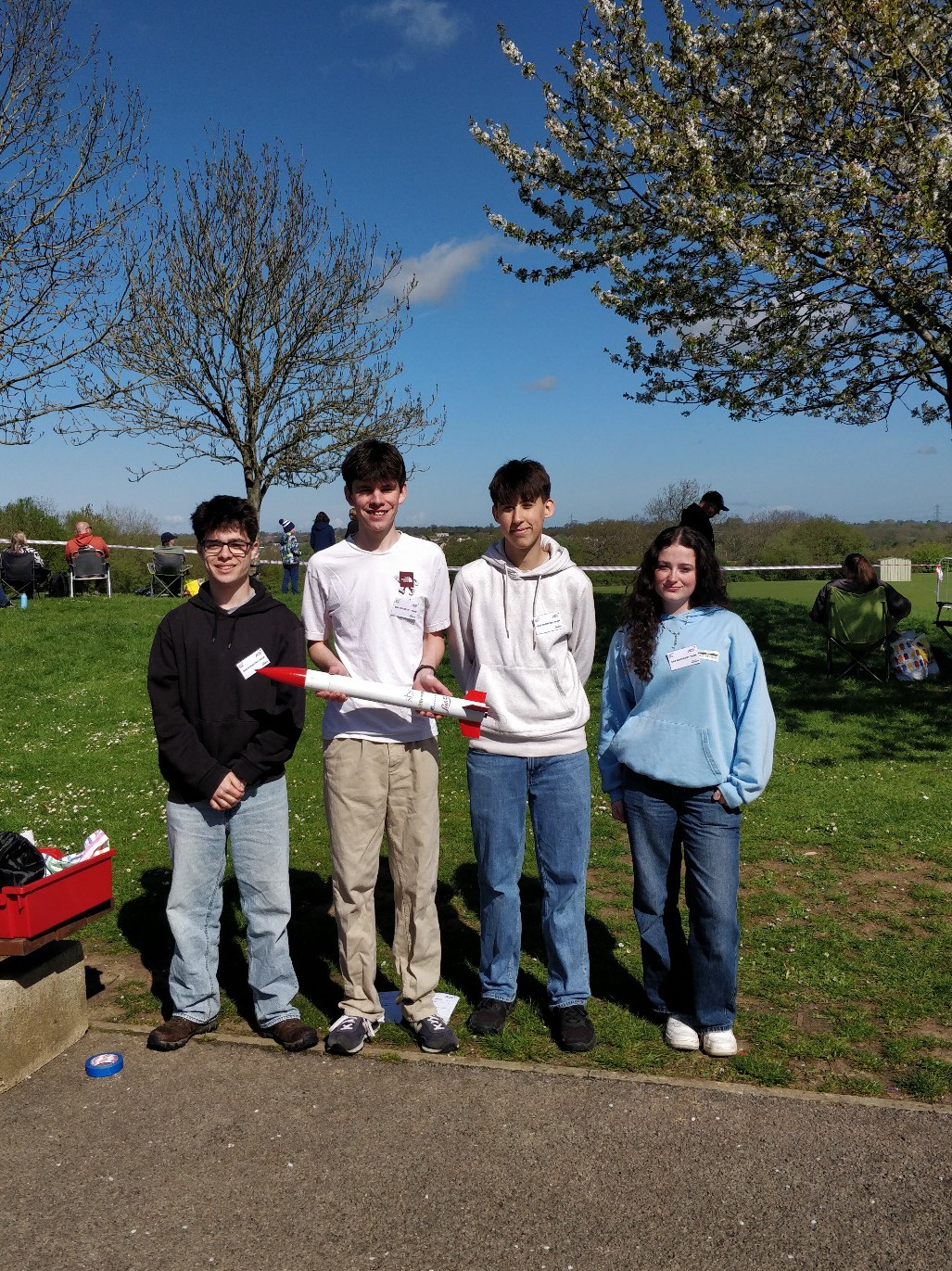
On Sunday 19th April, I and four other students from Stroud High School entered the UKROC South West Regional heat. This report chronologically details our activities and progress as a team, leading up to and during the competition.
UKROC is a competition run by ADS, where students aged 11-18 compete to design and construct a rocket to meet a given brief, without the assistance of people external to the project. This year, the task was to design a rocket of a specified size and mass, to fly to 750ft (228.6 m) within 36–39 seconds, whilst carrying an egg without damage to that egg. (UKROC, 2025a)
Initiation
The team started in December of last year after I asked a few of my friends whether they would be interested in forming an entry. We all share a physics class and have a common interest in STEM for our futures.
As well as team members, the competition also requires that every team has a responsible adult(s) to oversee our activities, as the competition is for 11-18 year olds. After some deliberation, our Physics, and Mathematics teachers agreed to participate as our responsible adults. However, this was mainly for the administration aspect; the team members controlled the majority of the project and all of which is detailed below.
Since I was the only member with experience in Model Rocketry, I proposed that the project should be completed in two stages. 1) Each member would build a small rocket based on a design I had previously made and flown, to learn the theory of the rocket’s flight and how to construct a rocket. 2) Once every member had an understanding of a model rocket we would move onto the construction of two, larger, identical rockets which would serve as our competition entry (where one airframe would be our main aircraft, and the other would serve as backup in case of catastrophic failure).
Sponsorship
Before we could begin on the construction of the rocket, we needed to gather some funding in order to purchase all the parts and for any administration fees. Initially, we worked towards a rough conservative estimate of the total project cost provided within the UKROC project guidance documents of £200 (UKROC, 2025b), however this was later altered as I was able to produce a more accurate costing using our designs, of £108.
This funding took the form of sponsorship from local companies and from parents. To find local businesses who would sponsor our project, we generated a list of 59 local engineering firms who we thought could take interest in our project to cold email. Of this list we had 7 responses, and only one which resulted in a sponsorship. Additional funding was gathered through 3 of the members parents. I also contributed any relevant materials I had in my stores towards the project.
I managed the finances of this project through a costings spreadsheet which I produced. Within this document is: a record of the cash flow, bills of materials for the separate rockets, a combined and simplified bill of materials for the entire project, and a record of the sponsorship received.
Design
As mentioned above, there were two rocket designs used in this project.
The first, the small rockets, are a design which has been flying successfully for two years as a test bed for my eALT altimeter (the design process is detailed here). These are BT-20 rockets which are simple to build and have reached an altitude of 60m on an A10-3T, and 315m on a C12-6FJ rocket motor. They are entirely scratch built, and demonstrate how to construct a motor mount and fin set.
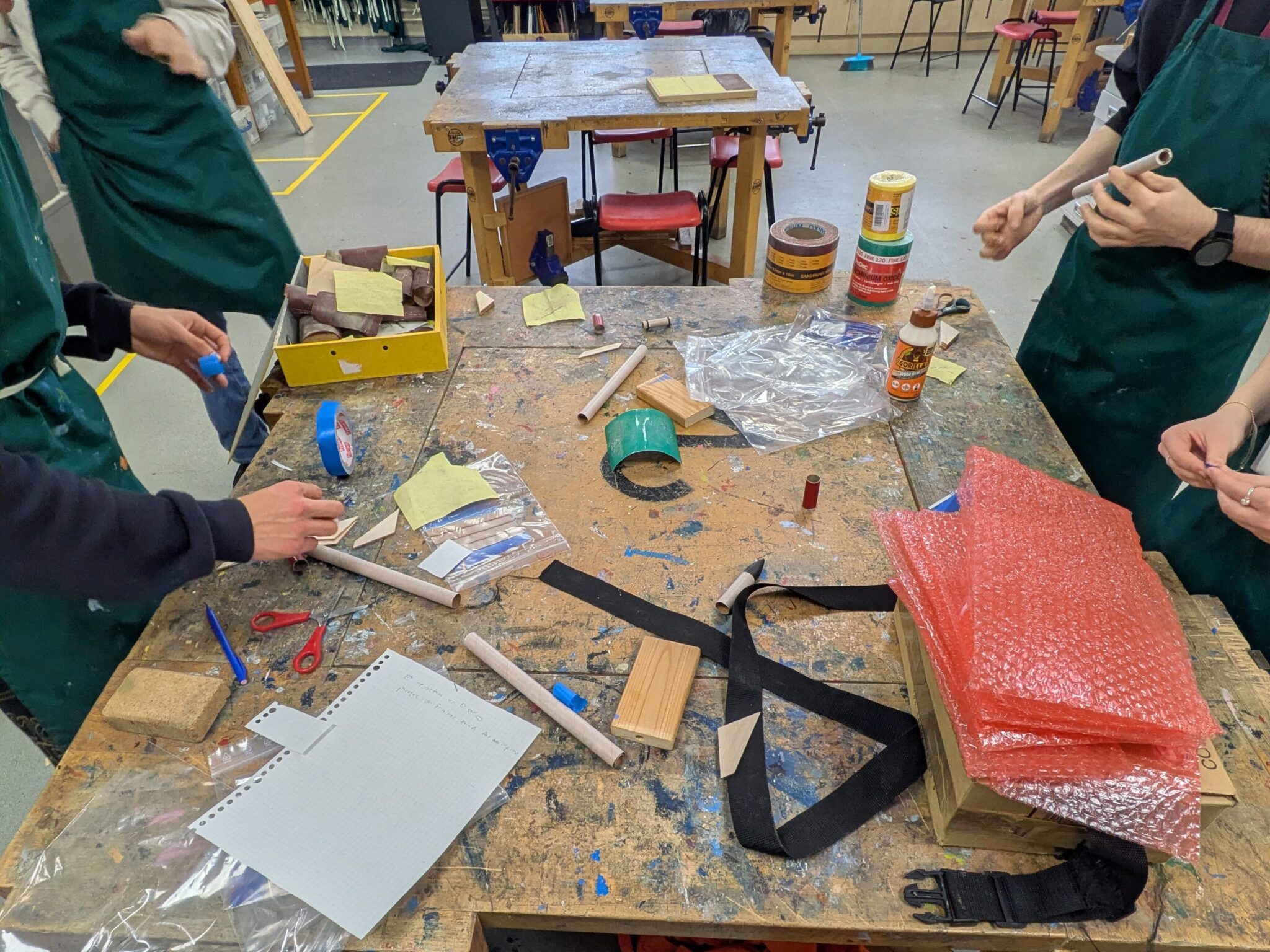
The second is the competition design. This design followed an iterative approach in order to reach the design which we flew at the heat. My initial plan for this design was to create a simple and light design which would fit to the design constraints given by the rules. The main limitations were the following: (UKROC, 2025a)
- Minimum body tube diameter, 47 mm (BT-70 body tube)
- Minimum length, 650 mm
- Payload mass, 55-63 g
- Maximum takeoff mass, 650 g
- Maximum motor impulse, 80 Ns (equivalent to an F-size rocket motor)
I addressed the minimum length and diameter by setting the rocket to be those dimensions. The payload mass impacted the stability of the rocket stability significantly, depending on where along the body the egg was positioned. The best position was in a dedicated payload bay just below the nose cone, so that the centre of gravity was as far above the centre of pressure as possible, to improve the stability of the rocket (NASA, 2023). The maximum mass was less of a constraint that I was concerned about, as I was prioritising a low mass. For my motor impulse, I found that the restriction would not be an issue, as the impulse I needed was much lower. Instead, I tested a motor which I already had stock of (an E26-7W motor), and it was coincidentally able to get the basic design relatively close to the targets, with some headroom above the target altitude to allow for adjustment over time.
Having a headroom …
Having a headroom is useful as mass can be added to the rocket to reduce the apogee to be closer to the target. It is more effective to have ballast than an exactly preset rocket mass, as out of control factors like wind and gust speed would require a new rocket, which in a windy country is not suitable.
This theoretical first design rocket ended with a mass of 190 g and fit all the requirements set out by the rules. However, this model did have some flaws relating to the egg, as the rules were less prescriptive in this area. As a result we went through n iterations to work out how to hold the egg. Our first idea was to hold the egg within a form inside the nose cone, however this would make the nose cone too fragile (0.3 mm thick in places) and too heavy (>70 g). When this was simulated, it would impact the altitude by 50 metres, removing the altitude headroom mentioned previously. The second idea was to make a hollow nose cone to with a with thin walls but which is still strong enough to hold together on landing, and to place the egg within a lower payload bay. This resulted in a nose cone with a mass of 21 g and a minimum wall thickness of 0.8 mm. While the egg was lower down the rocket the stability was still high enough that it would not be unstable.
The second idea is what ended up in our final rocket.
The other aspect which took some deliberation was the egg holder. We needed a material which would hold the egg in place whilst being able to cushion its fall and impact with the ground. Several ideas were considered: the solid plastic, cotton wool, agar, and bubble wrap. But the material we decided upon was starch-based packing peanuts, which were found within the packaging for the body tubes that were purchased for the project. These have a mass of <0.1 g each but are able to cushion the egg enough to prevent damage.
The final design we had was the following:
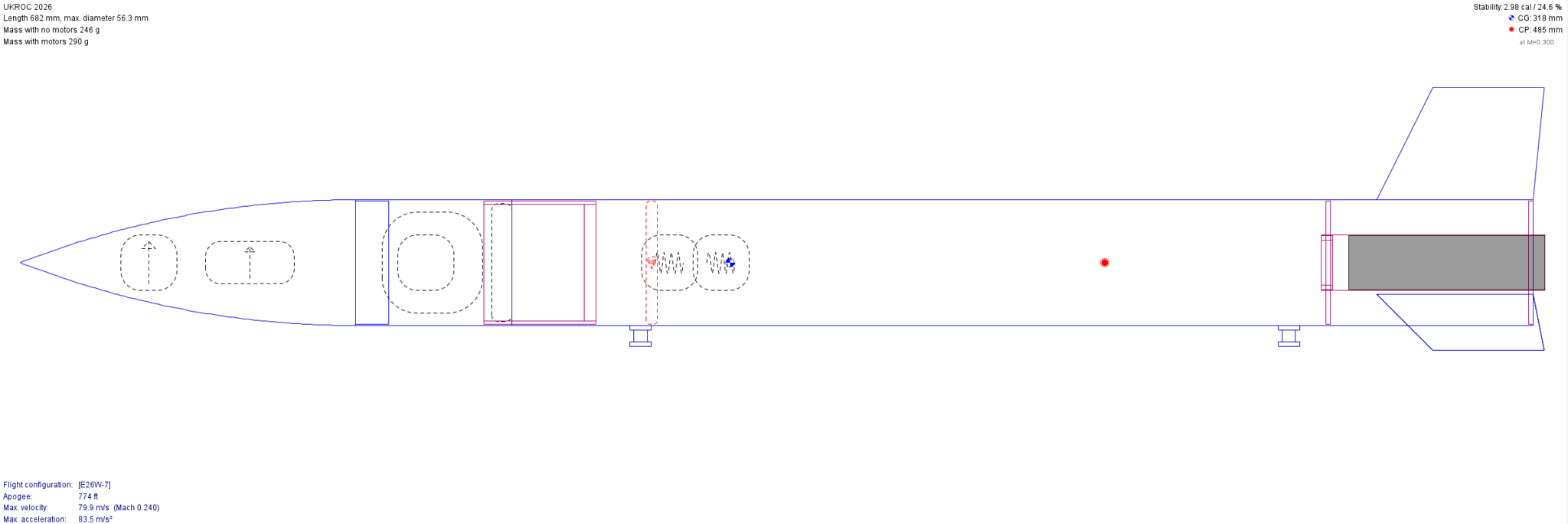
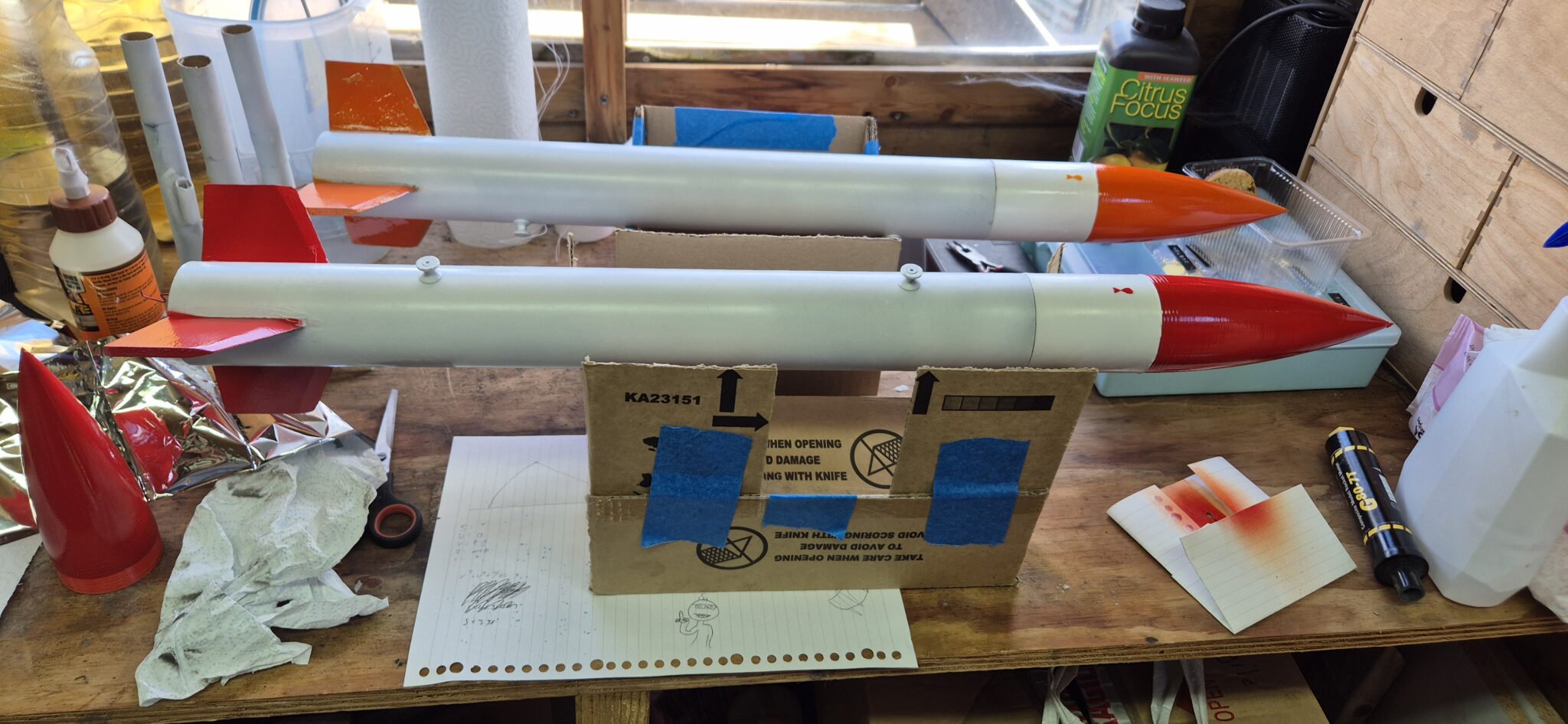
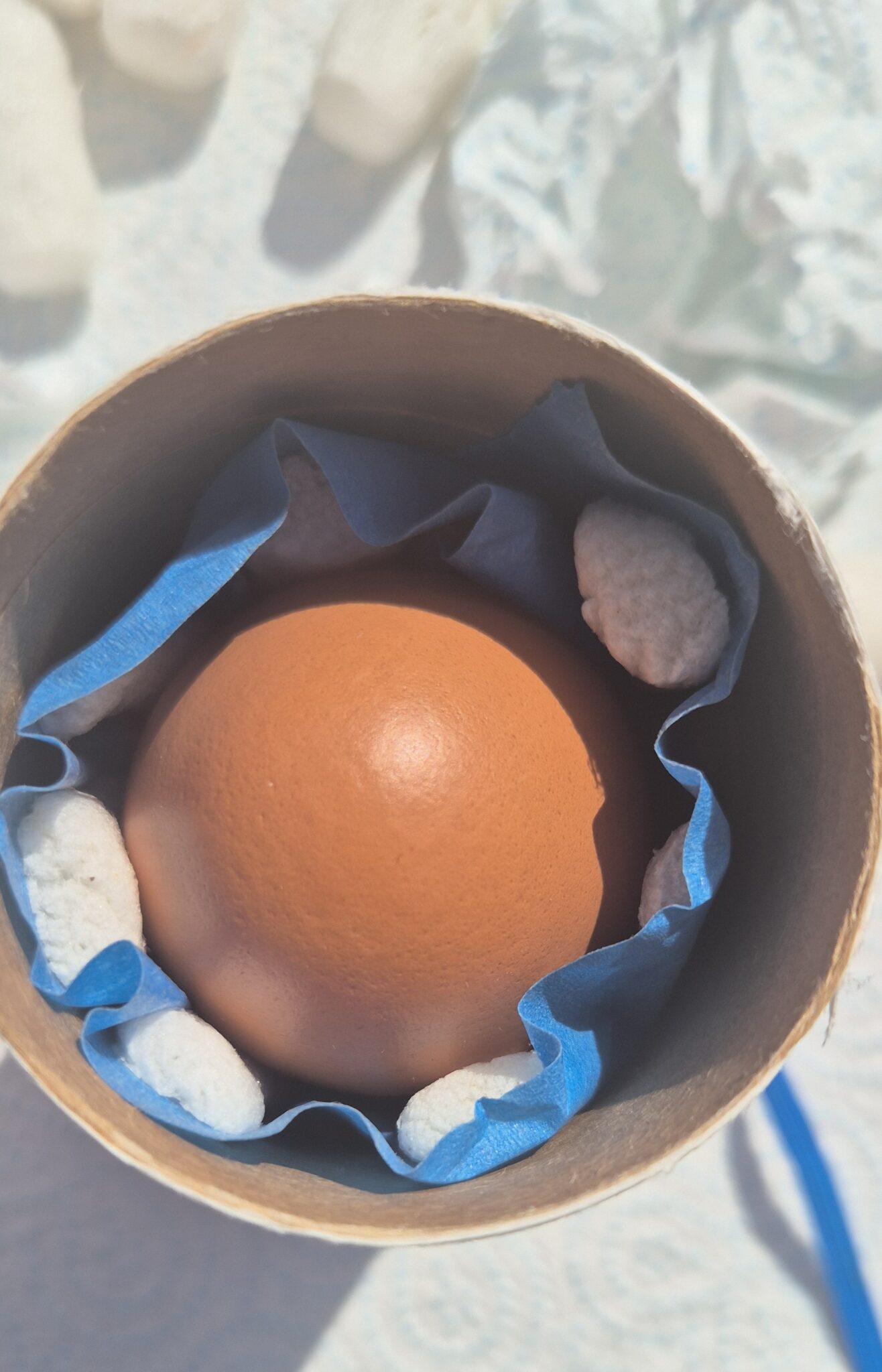
Its length is 682 mm, its diameter is 56.3 mm and its take off mass is 290 g.
Testing
Before competing at the heat, we conducted some testing to ensure that all aspects of the rocket would work as expected.
Ground Testing: part 1
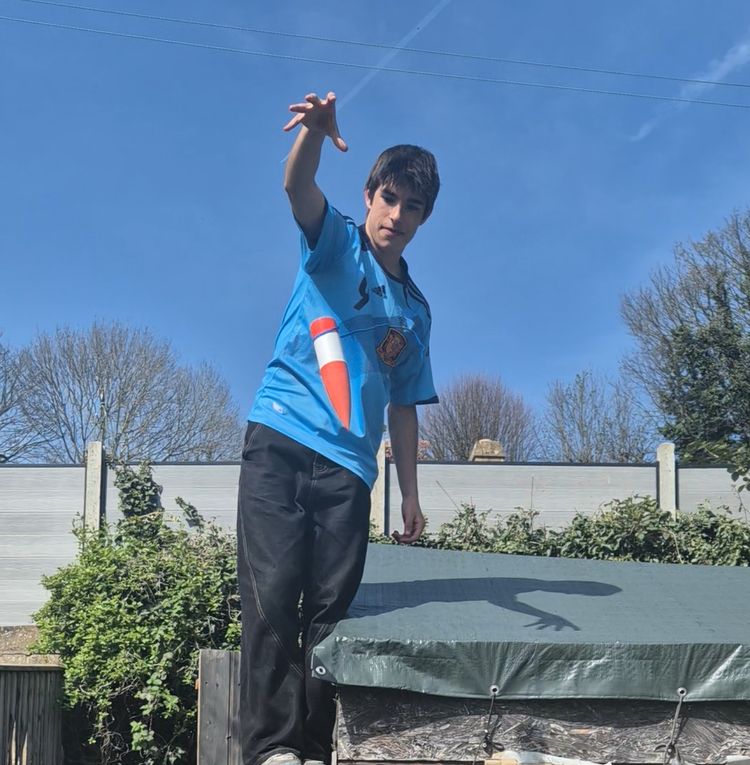
The first phase was ground testing, to make sure that the egg protection would function correctly. Our simulation software, OpenRocket, is able to predict what speed the rocket will hit the ground (8 ms-1), which we were able to use to determine the height to drop the payload bay from in order for it to hit the ground at the same speed using an equation of motion for constant acceleration. This drop test was then used to verify (or disprove) several of our ideas about what would be a suitable egg holder. From this, we determined that the starch-based packing peanuts would be the best and easiest to implement for our use case.
FOG
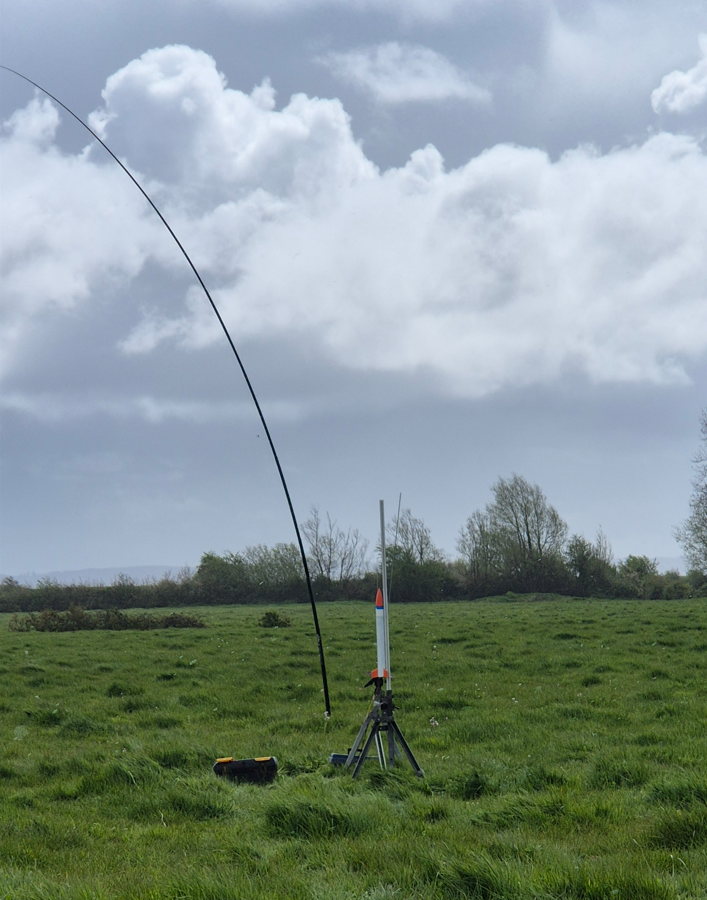
On Sunday 12th April, we attended a launch event at Fins Over Gwent Rocketry Club in South Wales. Here we were able to fly our small rockets, which all flew successfully (including and altitude record for that rocket of 72 m), and do a test flight of our competition rockets.
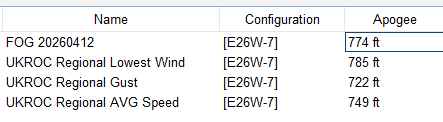
During this test, there was a stronger wind than we hoped for but the rocket launched successfully to 238 m. This was 10 m above the target altitude, giving us a large enough headroom to adjust on the event day, when the wind speed would hopefully be lower. However, after reaching apogee, whilst the payload bay was popped correctly, the shock chord snapped, disconnecting the payload bay and parachute from the rest of the airframe. On top of this, the parachute did not release properly. This resulted in both sections of the rocket falling ballistically and separately.
We were able to retrieve the payload bay and egg. Predictably, there was little left intact of the egg when we retrieved it; the shell had shattered entirely from the impact with the ground, and the egg yolk and white had coated the starch-based packing peanuts and the altimeters. We estimate that the payload bay hit the ground at 68 ms-1.
The remainder of the rocket is still in a field in South Wales, so we were unable to find if any other aspect of the rocket had failed, but based on our observations the shock chord snapping was the most likely cause.
Ground testing: part 2
Our first change was to the shock chord. During the test flight, we used elastic chord which was roughly and eighth the length of the rocket body. The length was the main issue as there was not enough time for the payload to decelerate after ejection, so a much greater force was exerted on the shock chord than was necessary. In our modifications, we made the shock chord three times the length of the rocket body.
We also decided to change the material of the shock chord. While elastic can be an effective material for a shock chord on rockets without a payload, a google search can find that the alternative material Kevlar is a better choice. In our research we found that the ultimate tensile strength of Kevlar is 3.6 GPa (DuPont, 2017), while the ultimate tensile strength for the rubber used within a shock chord is 0.01-0.1 GPa (The Engineering Toolbox, 2003).
Our final change was to the egg packing. To prevent the need for the contents of the egg to be cleaned from the electronics again, we placed the egg inside a resealable polythene bag. This had the added benefit of providing some spacing around the egg from the rest of the payload, if some air was left in the bag when placed inside the payload bay.
We were unsure how to solve the issue of parachute deployment, and as a result made no change to its attachment, relying on the longer shock chord to improve the chute deployment. Some drop testing was attempted with just the payload bay, which showed the parachute could release successfully when outside of the rocket body.
Issues encountered
Through out the project we experience issues with every aspect of the process, most of which are discussed as they happened above. On top of those, we also encountered issues with our insurance cost, and the altimeters.
One of the conditions for entry to the competition is that teams have British Model Flying Association (BMFA) Youth Group insurance. This was initially communicated to us as £47 (UKROC, 2025c), however conformation from the BMFA moved this to £51. As discussed before we had two teachers acting as official responsible adults for the project, so both needed to be listed on the insurance. When we submitted our application to the BMFA for our insurance, they doubled the price to £102. Since both teachers would not be attending the launch events at the same time, only one adult’s insurance was actually needed so I negotiated back to the original £51, as the higher price would have severely hindered our ability to complete the project, due to the large section it took from our budget.
Our other issue was with the altimeters. In order to ensure that the altitude scores are correct for the competition, a set of of allowed altimeters are provided which are supposed to collect accurate data. For our rocket, we decided to use the Mercury V1 altimeter which was new to the competition this year. In our flight testing, we were unable to find an accurate altitude reading, though ground testing did show the altimeter was working. This continued to be an issue in the competition, as is discussed below.
Competition Heat
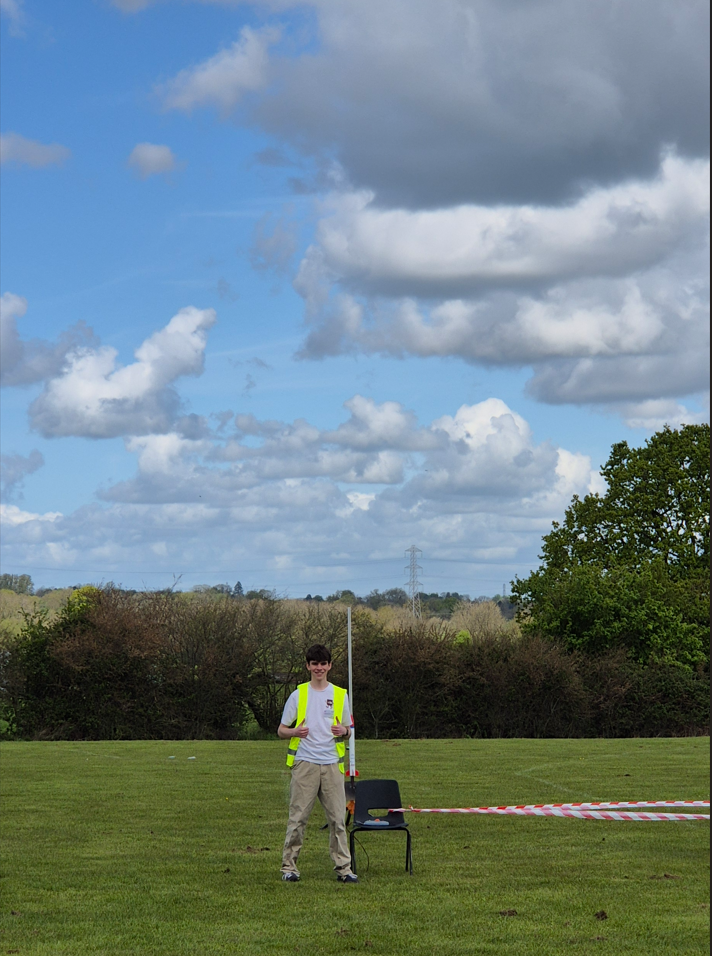
Sunday 19th April was the South West Regional Heat, and our opportunity to confirm that the rocket was a suitable launch vehicle. We were allowed 3 launches, rather than the typical 2, due to our altimeter issues.
Flight 1
In our first flight, we had a second successful takeoff and ascent. At apogee, the payload bay ejected successfully with the Kevlar shock chord still intact. However, our parachute failed to deploy properly, and so did not provide enough drag to slow the flight significantly. When it hit the ground, the entire rocket bounced breaking the egg, but the airframe was not damaged. Unfortunately, our altimeter troubles continued from the previous weekend, and only a 2 metre apogee was recorded. Since the egg cracked and the altimeter failed, this flight did not achieve any score.
After this flight, we swapped the parachute to a smaller one which had flown successfully before on one of my other rockets. I also attempted to reduce the chance of any altimeter miss readings due to the approach to the launch pad, so we agreed that we would switch on the altimeter as late as possible.
Flight 2
In our second flight, we had another successful ascent and ejection, but this time our parachute also released properly allowing a slow, steady descent. Our egg was not damaged, so we were hopeful for an altitude close to the target height. But again, we had no readings from the altimeter, disqualifying the flight.
Rather than admitting defeat, I agreed with the event organisers that we could attempt one extra flight with one of their own altimeters, which had been shown to provide accurate readings. This was only allowed after we demonstrated that the altimeter could record data when on the ground, inside the payload bay.
Flight 3
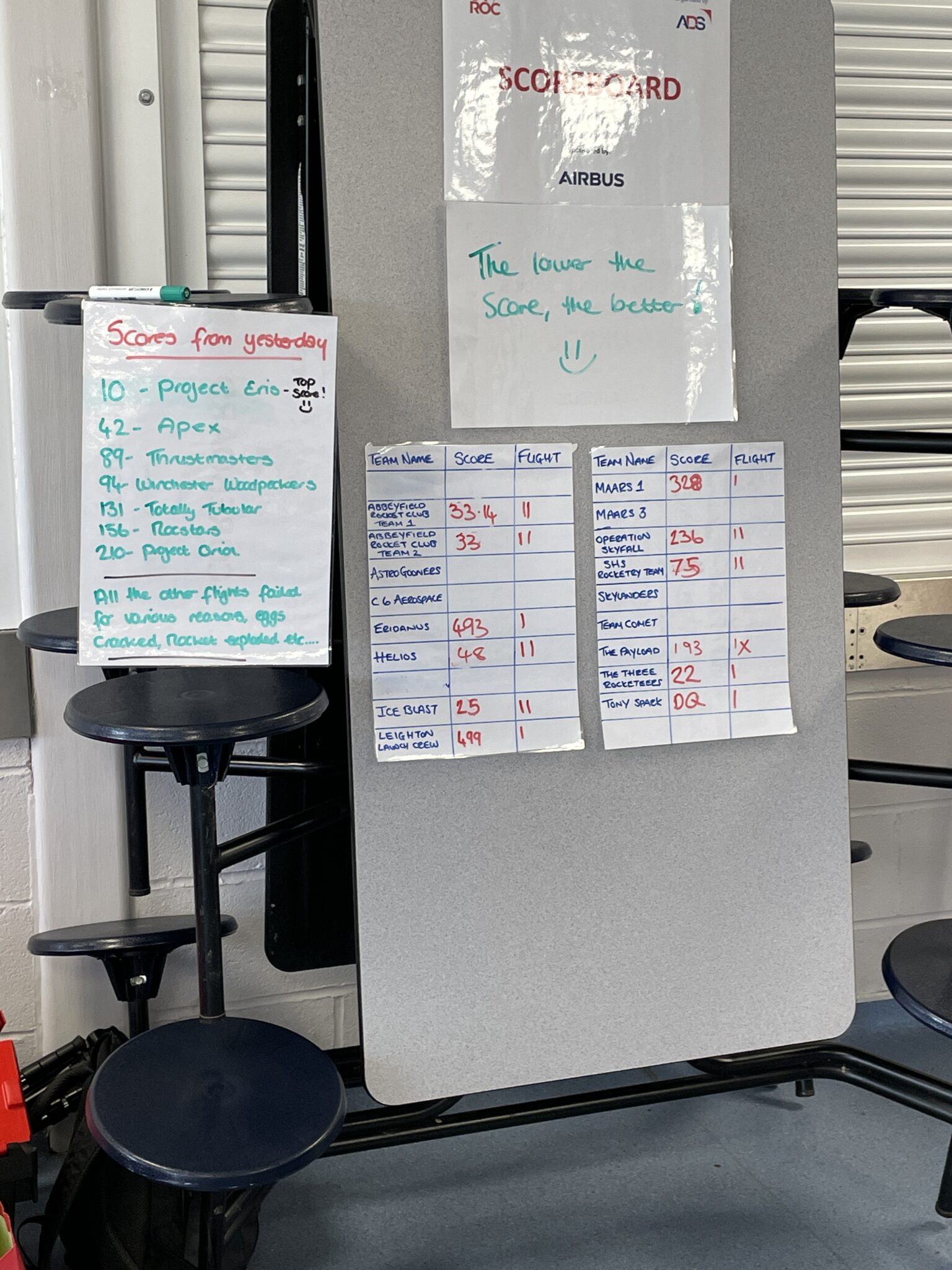
On our third flight, we had another successful launch and landing. The egg was not damaged, and we were able to finally get an altimeter reading! Our apogee was 209 metres (686ft), and our flight time was 33 seconds. This gave us a final score of 75 points (the lower the better), which was above a large amount of other flights but not the best score of the day.
Conclusion
From this project, I have been able to learn and practice the project management and team skills required for a successful engineering project, alongside the development and construction of rockets. I was also able to share my hobby of model rocketry to my teammates, some of whom may hopefully continue with the hobby after the competition.
Acknowledgements
Although I am the person writing this report, there are several people who deserve thanks for the role they played in getting this project to launch. My teammates Ayden, Leo, Cerys, and Simon for putting work into the project on top of their schoolwork. My teachers Dr Burton, and Dr Manson-Whitton who agreed to look after the project. My Mum, for keeping us fed when we invaded the house to build the rockets over several days. My Dad who taxied us between all of the events, and helped purchase rocket motors. Our sponsors, LB Bentley, Lister Shearing, and eMAKER ltd. for funding our project. And to Fins Over Gwent Rocketry Club, for allowing us to test fly our rockets.
References
DuPont (2017). Kevlar Aramid Fibre Technical Guide. [On-line] Available at https://www.dupont.com/content/dam/dupont/amer/us/en/safety/public/documents/en/Kevlar_Technical_Guide_0319.pdf [Accessed: 20th April 2026].
Glenn Research Center, NASA (2023). Rocket Stability. [On-line] Available from: https://www1.grc.nasa.gov/beginners-guide-to-aeronautics/rocket-stability/ [Accessed: 21st April 2026].
The Engineering ToolBox (2003). Young’s Modulus of Elasticity – Values for Common Materials. [On-line] Available at: https://www.engineeringtoolbox.com/young-modulus-d_417.html [Accessed: 20th April 2026].
UKROC (2025a). UKROC Rules. [On-line]
Available from: https://www.ukroc.com/wp-content/uploads/2026/02/UKROC-2026-Rules-v2.pdf [Accessed: 20th April 2026].
UKROC (2025b). UKROC Team Handbook. [On-line] Available from: https://www.ukroc.com/wp-content/uploads/2026/03/UKROC-Team-Handbook-2026_compressed-1.pdf [Accessed: 20th April 2026].
Leave a Reply